
High-quality content for SEO is a page that gives a local customer exactly what they came for, fast, on a phone, with proof you know the job. That's it. Not word count. Not keyword stuffing. If a homeowner in Riverside searches "AC not cooling" and your page tells them what to check, what a fix costs and how to reach you today, you wrote quality content. If your page says "we provide top-notch HVAC solutions," you didn't.
The catch: good content on a slow, clunky site still loses. The words and the site work together. That's why we build the site first and write for it second.
TL;DR
- Google rewards helpful, people-first content: original, complete, and written for readers, not for search engines.
- For a trade business, quality means answering one job-specific question per page: the problem, the price range, the service area, the next step.
- Write like you talk on a job site. Short sentences. Real examples from your own work.
- Check Google Search Console every month. Update pages that get impressions but few clicks.
- Content lives on your website. A site that's slow or hard to use on a phone wastes good writing.
Table of Contents
- What Google actually means by "high quality"
- Why trades need a different kind of content
- The seven pages that do most of the work
- How to choose what to write about
- Write the page: a plain method
- Content isn't only words
- Speed matters after the click
- Keep it fresh, but don't churn
- Measure it with Search Console
- Mistakes that sink trade content
- What we do about it
- Our take
- FAQ
- Sources
What Google actually means by "high quality"
Forget the SEO blogs that sell magic formulas. Google publishes its own guidance, and it's plain.
Google's guidance on helpful, reliable, people-first content says good content offers original information, a substantial and complete description of the topic, and clear signs of expertise. It also says the reader should walk away feeling they learned enough to reach their goal. Content made mainly to catch search traffic is the opposite.
Google's SEO Starter Guide goes further. It says compelling, useful content likely influences your search presence more than any other factor. It also tells you to go back to old pages, update them, or delete them if they're no longer relevant.
Translate that for a contractor:
- Original means your pricing, your process, your photos, your city. Not a paragraph copied from a national directory.
- Complete means the page answers the follow-up question before the customer asks it.
- Expertise means you show you've done the work. A roofer who explains why tile roofs in the Inland Empire fail at the underlayment, not the tile, sounds like a roofer.
- People-first means the page is for the homeowner with water on the floor, not for a robot.
One more point from the trade press. Search Engine Journal puts it this way: quality is whatever the user needs at the moment they're searching. A long essay fails someone who wants a two-sentence answer. Your customer with a dead water heater wants the answer and a phone number.
Why trades need a different kind of content
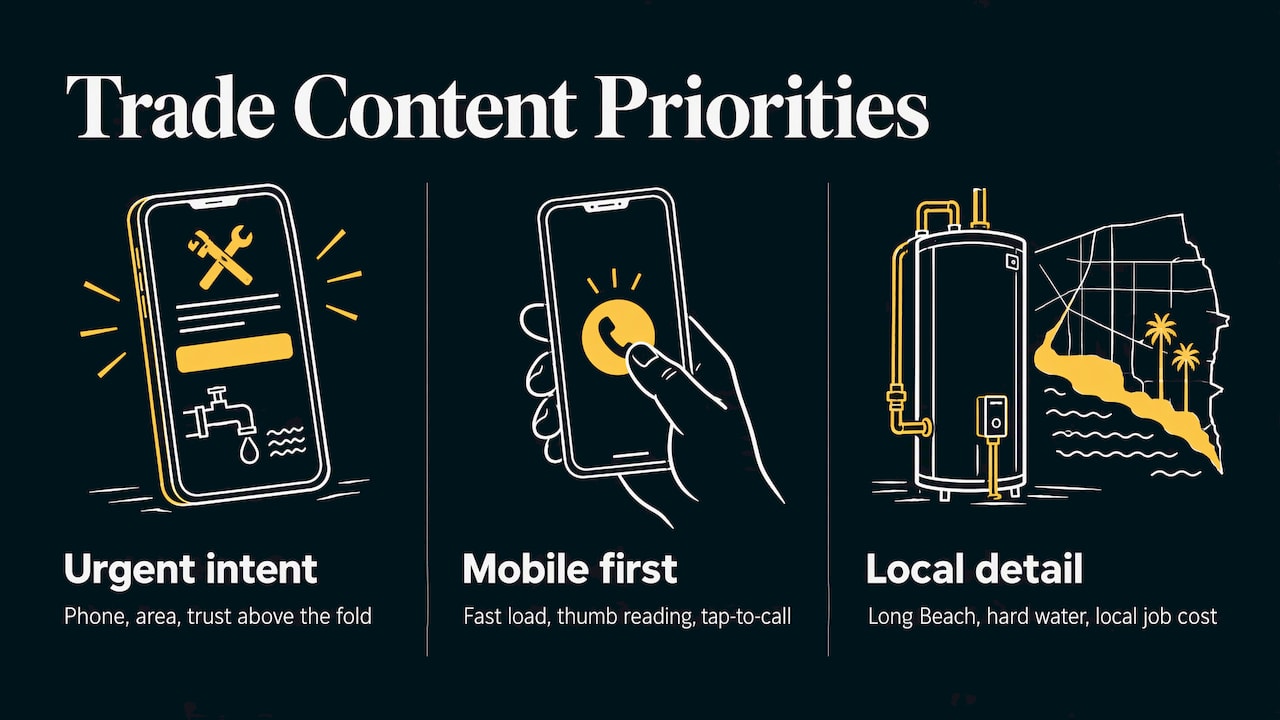
Most SEO advice is written for bloggers and software companies. You sell a service in a service area. Your customer is local, in a hurry and holding a phone.
That changes three things.
Intent is urgent. Someone searching "emergency plumber Pasadena" will call the first credible result. They won't read a 2,000-word guide. Your page needs the phone number, the area and a reason to trust you above the fold, which means on the first screen without scrolling.
Mobile comes first. The page has to load quick, read easy with a thumb, and have a tap-to-call button. Google's own starter guide says titles and content should work on mobile versions too. A page that's great on a desktop and awkward on a phone is not high quality for your customer.
Location is part of quality. A page about water heater replacement means more when it names Long Beach, the hard water there and what the job runs in your area. We cover this in our guides on service area pages and service area business SEO.
The seven pages that do most of the work
You don't need a blog with 200 posts. You need a small set of pages that each do one job well.
- Service pages. One per core service. "Water heater replacement." "Roof repair." "AC installation." Each explains the job, who it's for, what affects the cost and how to book.
- Service area pages. One per city you really serve. Real local details, not the same text with the city name swapped.
- Pricing or cost pages. More on this below. They convert.
- Project pages. Before and after photos, what the problem was, what you did. Real jobs only.
- FAQ content. The questions customers ask you on the phone.
- About page. Who owns the company, how long you've been at it, your license and where you work.
- Contact page. Phone, form, hours, service area. Simple.
If you're an HVAC company, our HVAC SEO guide shows how to get those pages ready before the first heat wave. Plumbers can use the local SEO playbook for plumbers, and roofers the roofing version.
The same logic works for car washes, salons and restaurants. A salon in Monrovia needs a page per service with a price range and a booking button. A restaurant needs the menu as real text, not a photo of a PDF. Google's guide warns against putting text inside images, because people can't copy it and search engines can't read it.
How to choose what to write about
Start with what customers ask, not with a keyword tool.
Search Engine Land's audience research guide suggests mapping your ideal customer's journey: their problems, what they want and how they search for it. For a contractor that map is short. Think of the last ten calls you took. What did each person ask first?
A simple routine:
- List the ten questions you answer most often.
- Pick one to three focus topics. Don't chase everything.
- Type each into Google on your phone. Look at who ranks and what format they use: service page, list, video.
- Check the "People also ask" box. Search Engine Land says answering those follow-up questions is one of the best ways to be helpful.
- Write the page that answers better than what's there.
Search Engine Land's content strategy guide adds a check worth using: look for proven demand, clear intent and manageable difficulty. For a local business, "manageable" usually means a city plus a service, not a national term.
Write the page: a plain method
Here is how a good service page gets built.
1. Lead with the answer
Put the answer in the first two sentences. "We replace tank water heaters in Orange County, usually in one visit. Call for a same-day quote." Then explain.
2. Cover one job per page
Search Engine Land's optimization guide says good content helps the reader finish one specific task and points them to the right next action. For you the task is booking a job. One page, one service, one next step.
3. Use your own proof
Original beats generic. Add things only you have:
- Photos from real jobs
- The most common problem you see in a given city
- What you do differently on the job
- Your license, insurance and years in business, if you have them
A generic example: a plumber in the San Gabriel Valley writes up a slab leak repair. The page covers the warning signs, the steps in the fix, and how long it takes. That page has details a competitor's template can't copy. Search Engine Land notes that real-world examples and stories make content more memorable and can raise time on page.
4. Talk about cost
This is where most trade sites chicken out. Search Engine Land's local business content guide reports that including cost and pricing information helps rankings and may earn featured snippets. Its tests found that optimizing for cost keywords improved ranking, traffic and conversions.
You don't have to post a fixed price. Give a range, and say what moves it: size, access, permits, parts. Label it as an estimate. A customer who sees a range and still calls is a better lead than one who bounces.
5. Structure it for thumbs
Google's starter guide says to write easy-to-read, well-organized text in logical chunks and to use headings like an outline. In practice:
- Short paragraphs, two to four lines
- A clear heading every few paragraphs
- Bullets for lists
- A tap-to-call button that stays in reach
6. Write the title and description
Keep the title brief, descriptive and natural. Say what you do and where. "Water Heater Replacement in Long Beach | Company Name" beats "Best Plumbing Solutions." The meta description is the line under the title in search results. Use it to tell people what they get. Search Engine Land's SEO overview lists title tags, meta descriptions, header tags, image alt text, internal links and clean URLs as the core on-page pieces.
7. Link your pages together
Link service pages to the area pages and the project pages that match. Your Google Business Profile should point to the right page too. See our guide on Google Business Profile for contractors.
Content isn't only words
Images need alt text, which is a short plain description of the photo. It helps people using screen readers and helps Google understand the picture. Name files like what they show. Compress them so the page loads fast.
Video can help too, but don't bury key info inside it. Put the same facts in text on the page.
Speed matters after the click
A customer who finds your page and waits six seconds for it to load is gone. Content quality includes the experience of reading it. We also care about how fast a lead gets an answer once they reach out. Replying quickly is one lever in paid local ads, and this piece on fast lead response for Local Services Ads shows how it ties into ranking and booking.
Keep it fresh, but don't churn
Search Engine Land's local content guide recommends evergreen pages you refresh, not weekly posts that lose relevance. We agree. Twice a year, go through each page and ask:
- Is the price range still right?
- Are the photos recent?
- Did we add a service or city?
- Is the phone number correct?
Google's starter guide says to update old content or delete it if it's no longer relevant. Seasonal prep is a good reason to update. In Southern California, think AC tune-ups before summer and roof checks before the first big rain.
Measure it with Search Console
Google Search Console is free. It shows how your pages do in search. Google's Performance report guidance tells you to track clicks, impressions, click-through rate (CTR) and average position. It says to focus more on trends in impressions and clicks than on position alone. For pages with low CTR, try updating the title and description, or match the content better to the queries bringing people in.
Google's Search Console overview says the report breaks traffic down by query, page and country. Use it monthly:
- Open the Performance report.
- Sort pages by impressions.
- Find pages with lots of impressions and few clicks.
- Rewrite the title and first paragraph to fit what people searched.
- Check back in a few weeks.
Be patient. Search Engine Land's SEO results guide says to track organic traffic over 6 to 12 months. Google also warns that a single change is hard to measure, because news, season and competitors move results too. Compare against the same period last year.
The number that pays the bills is calls and booked jobs. Count them. Ask every new customer how they found you.
Mistakes that sink trade content
- Same page, new city name. Google calls out mass-produced, search-first content. Write something real for each area.
- Vague claims. "Quality service" says nothing. "Same-day repair in Anaheim" says something.
- No next step. Every page needs a phone number or button.
- Text in images. Customers can't copy it. Google can't read it.
- Stale pages. Old prices and dead services hurt trust.
- Slow, hard-to-tap mobile pages. Fix this first.
What we do about it
We build mobile-first websites for service businesses, then handle the search work that goes on top: Google local SEO, Google Business Profile setup and management and AI search optimization. The content you've read about above lives on the site, so the site is where we start.
Here's how it works. You get a free live demo of your site in 24 hours. Pricing is agreed up front. There's no long-term contract, and you own your site assets. Built first, paid after. You can talk straight to the builder.

After launch, optional care plans keep the site updated: Keep is $297 per month, Grow is $397 per month and Signature is $597 per month. See the pricing page for details, or look at sites we've built for trades and local shops across Southern California.
Our take
Most contractors don't have a content problem. They have a website problem.
They know their trade. They can explain a slab leak or a failing condenser better than any writer. But the site is slow on a phone, the pages are thin, and nobody can tell what cities they serve. So the good stuff never reaches anyone.
We think the order is simple. Build the site so it works on a phone. Put the real answers on it: services, areas, price ranges, proof. Then keep it current. Google's own guidance says the same thing in different words: be useful, be original, be clear.
That's why we show you the site before you pay. You see your pages, your phone number and your layout live in 24 hours. If it's not right, you've lost nothing. Built first, paid after.
M Mo
FAQ
Is SEO dead or evolving in 2026?
It's evolving. Google's guidance still says helpful, people-first content matters most. Search results now include more answer formats and AI summaries, so clear, well-structured pages with real local details matter more. Plain answers, accurate facts and good structure help in both.
Can a beginner do SEO?
Yes, for the basics. Write one clear page per service, name your cities, add a phone number and photos, and watch Search Console. Most owners stall because they're busy on jobs. If you'd rather hand it off, we build and optimize the site for you.
Is an SEO score of 92 good?
A score from a content tool is a rough guide, not a Google ranking factor. Google says there's no single score that decides ranking. Judge a page by whether it answers the customer's question and whether impressions, clicks and calls go up in Search Console.
How long should a service page be?
As long as it takes to answer the job fully, and no longer. Search Engine Journal notes a long story fails a reader who wants a short answer. Many service pages need only a few hundred well-chosen words, plus photos, a price range and a clear call to action.
Sources
- Creating Helpful, Reliable, People-First Content, Google Search Central
- SEO Starter Guide, Google Search Central
- How To Create High-Quality Content, Search Engine Journal
- How to do audience research for SEO, Search Engine Land
- Searchers just want you to be helpful, Search Engine Land
- Content strategy in 6 steps, Search Engine Land
- The complete guide to optimizing content for SEO, Search Engine Land
- How to create quality SEO content, Search Engine Land
- How to create local business content that converts, Search Engine Land
- What Is SEO, Search Engine Land
- Performance report (Search results), Google Search Console Help
- How To Use Search Console, Google Search Central
- How to measure SEO performance and results, Search Engine Land
- Does Replying Fast Help Local Services Ads Ranking?
Ready? Get a free live demo of your new site in 24 hours at nocturne.design.